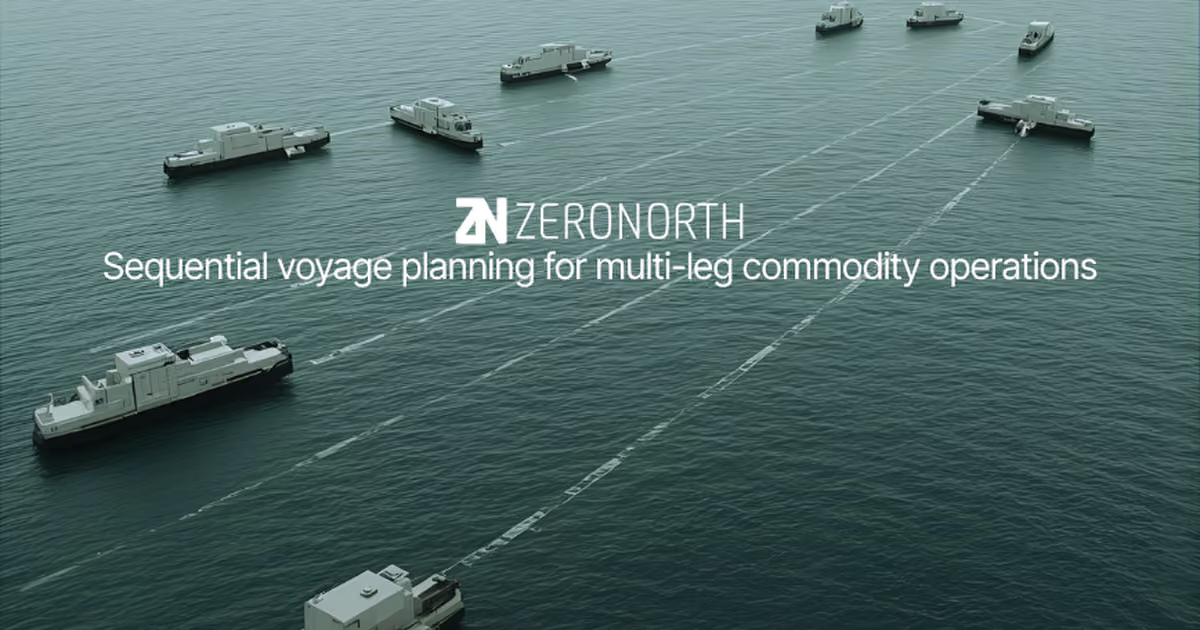
TL;DR: Sequential voyage planning means optimising a multi-leg voyage as one connected decision rather than one leg at a time. It matters because the best choice for a single leg is often the wrong choice for the voyage: arriving early at a congested port burns fuel to wait at anchor, and a cheap bunker stem on leg one can strand the vessel with expensive fuel on leg three. Sequential optimisation weighs speed, routing, bunkering and arrival windows across every leg at once, then re-optimises as congestion, weather and prices move.
Why leg-by-leg planning costs money
Most voyage planning is still done one leg at a time, because that is how the paperwork and often the org chart are arranged. The problem is that legs are not independent. Three failure modes recur:
Arriving early at a berth that is not free. Steaming hard to reach a congested port means burning fuel to sit at anchor. The fuel spent on speed is unrecoverable; the time gained is worthless. Sequenced planning slows the vessel to arrive when the berth opens, the practice known as just-in-time or virtual arrival, which is covered in more depth in slow steaming and speed optimisation.
Bunkering for the leg instead of the voyage. The cheapest stem at the next port is not always the right stem. If the vessel is heading into an emission control area, or towards a hub where the grade it needs is tight, the leg-optimal purchase can be voyage-suboptimal. Cross-leg bunker planning sits at the boundary between voyage optimisation and bunker procurement, which is exactly why the two decisions belong in one view.
Sequencing the ports in the order they were fixed. Port rotation is often treated as fixed when it is a variable. Canal fees, congestion and weather can make a different rotation, or a different canal, materially cheaper across the whole voyage even when it looks worse on the first leg.
What sequential optimisation actually does
Four mechanics distinguish it from leg-by-leg planning:
What it is worth
Honest framing matters here. Sequential optimisation does not add a separate saving on top of voyage optimisation; it is what makes the 3 to 10% per-voyage fuel saving achievable on complex trades, where leg-by-leg planning would give most of it back in port waiting time and mis-timed bunkering. The gains show up in four places rather than one: fuel burned, demurrage and idle days, laycan adherence, and the number of cargoes a vessel can carry in a year.
Where this sits against ordinary voyage planning
Sequential planning is not a different obligation, it is a harder version of the same one. The four SOLAS stages, appraisal, planning, execution and monitoring, still apply to every leg; see voyage planning for what regulation 34 actually requires. What changes on a multi-leg voyage is that stage 4, monitoring, has to look forward across legs rather than only at the current passage.
What to look for in the software
Five questions cut through the category:
- Does it optimise the sequence, or optimise each leg and concatenate the results?
- Are port congestion and berth availability inputs to the optimisation, or a separate dashboard?
- Can it price a change of port rotation or canal choice, including fees, across the remaining voyage?
- Are bunker stems planned across legs with grade availability and ECA boundaries included?
- When something moves, does the whole remaining sequence re-optimise, or only the leg in progress?
The broader selection framework is in the buyer's guide to voyage optimisation platforms.
The bottom line
On a single-leg voyage, leg-by-leg planning is sequential planning. On a multi-leg commodity voyage it is a trap: every locally sensible decision can add cost downstream. Planning the sequence as one problem, and re-planning it as conditions move, is what turns a chain of passages into one optimised voyage. Book a demo to see multi-leg sequencing on your own trades.